My name is Jurgen Roeland, I live in Belgium and I'm very proud to call myself an aircraft builder. Wish you a warm welcome to my builders blog.
Some people called me nuttzzz. Some people buy a porche when they get into the mid life crisis age. Other people take a second wife. Others get depressed. I decided to start building an airplane. A what ???? Yes, an airplane ! I skipped the phase of building the small plastic versions with glue and paint and went right into the real thing. My time is precious now so let's cut the obvious questions upfront. I heared them too many times already so here is the -mandatory FAQ reading- if you plan to visit my workshop. "You're building an airplane?" : Yes, I am. "A REAL airplane?" : Yes", "In your garage?" : Yes. " "One you can actually fly in?" : Yes! "You can do that?" : Yes!!!
If you look at history, it's been thousands of years that people have dreamed about flight and it's only in the last 100 years that we have now the opportunity to build our own airplanes and fly. The current project work is the results of years of deliberation, evaluation and planning. I took the advice of fellow builders very seriously and so should you. The type I have decided to build is the Van's aircraft, RV-7. I will motivate my choice in one of the subsections of this site. I hope you enjoy following my building adventures and that you will return frequently to check on the progress. The latest activity will always be posted on the main page.
For people that live nearby, feel free to come and have a look. Don't forget to bring a six-pack. The most frequently used lubricant in my workshop is called "Jupiler", bring some as I'm frequently running out of stock.
28+29+30/01/26 - Oil door p5 final install - 8h30
Now that the small epoxy parts are dry, it's time to do the final positioning and drill the outer latch case to the door. I placed it so far that when fully opened, it barely passes the aluminum strip on the cowl. The strip is not drilled yet so I will still be able to fine tune it with the latch rivetted to the door. For now the stip is parallel to the lower lip of the oil door opening. the hole is also drilled in the door itself. I used a step drill to open it up to the largest hole I could make with it. Some additional sanding was done to enlarge it and have the latch knob sit perfectly centered on the hole.
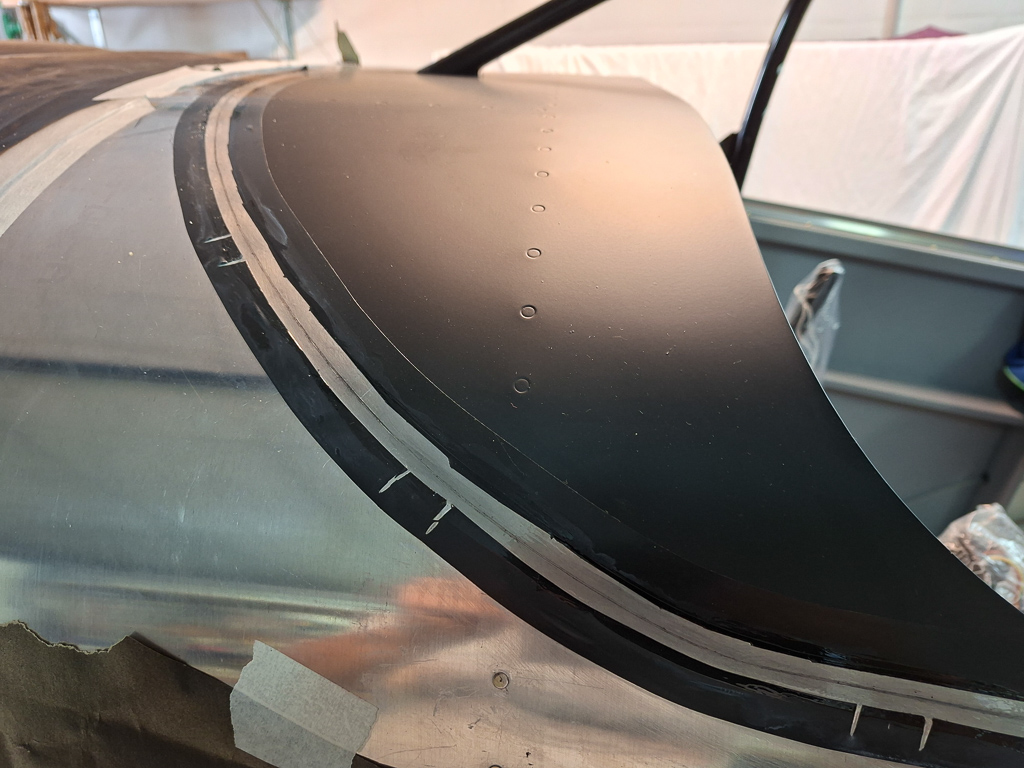
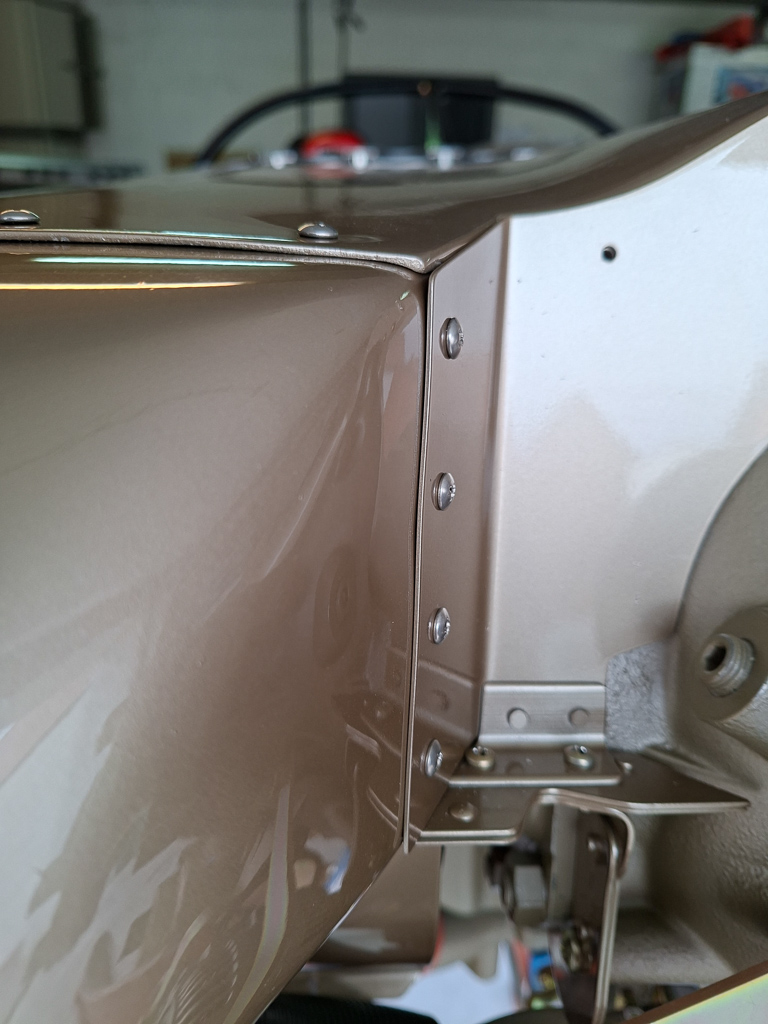
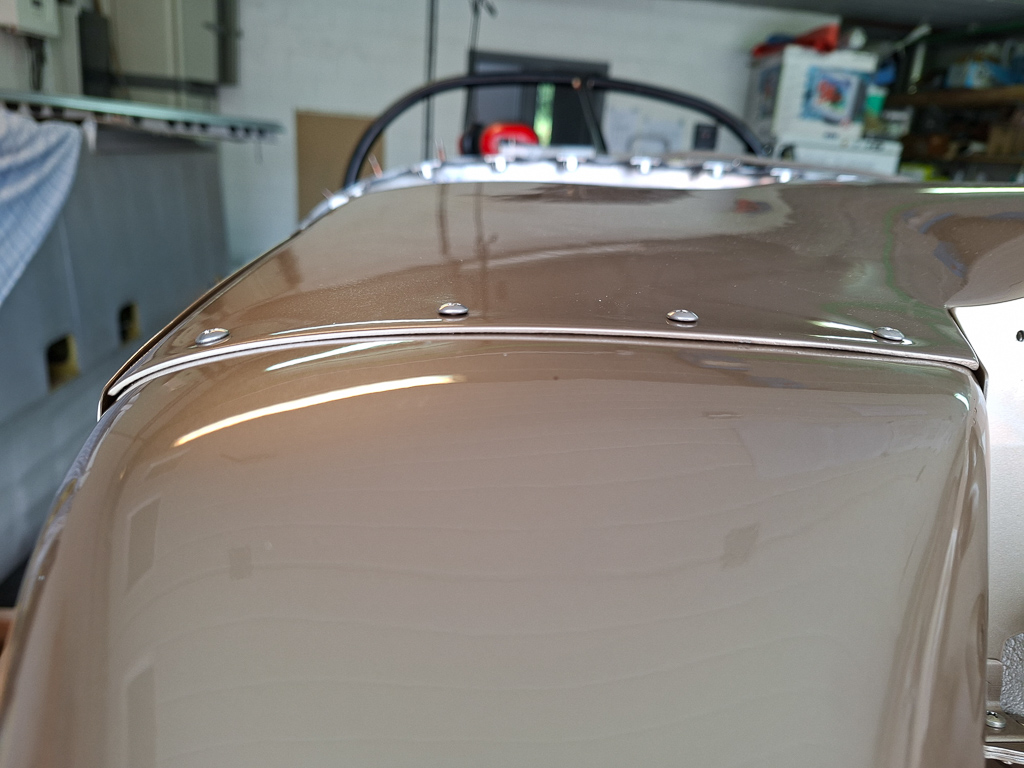
While the top was off , I did some more fine tuning on the paint gap at the firewall on the top cowling. This feels like a never ending story.
It looks quite good and consistent although it's still scary to have this size gap. I do hope the paint indeed closes this up and makes up for a nice butt to butt installation to the top skin.
Next I rivetted the latch on the door. That finalizes the oil door work.
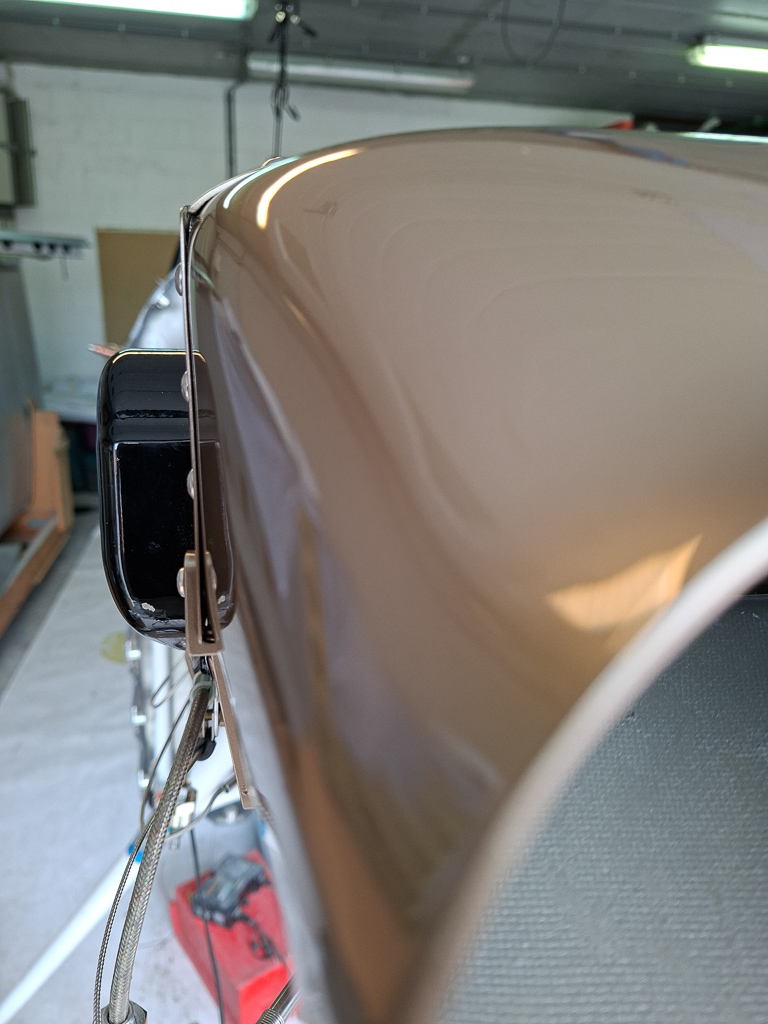
Here is the view from the inside.
It's easier now to explain how the latch works. By pushing the latch, you tilt the locking part upfront up
This is when you release it. You see the locking part moves forward. A spring holds it in place.
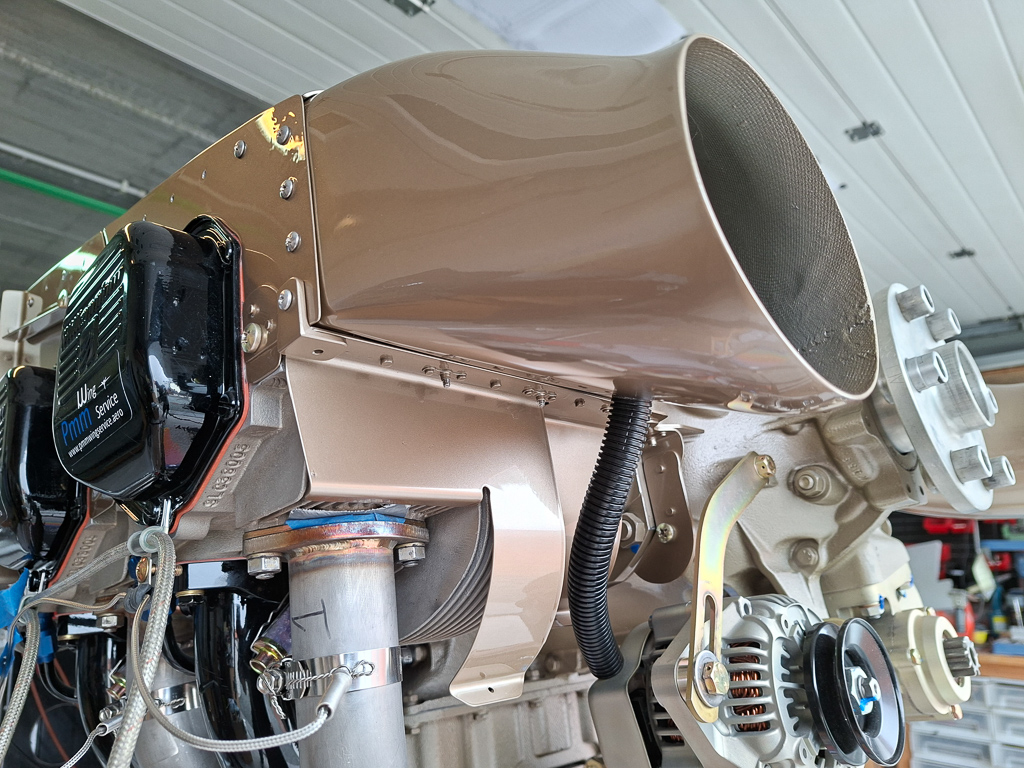
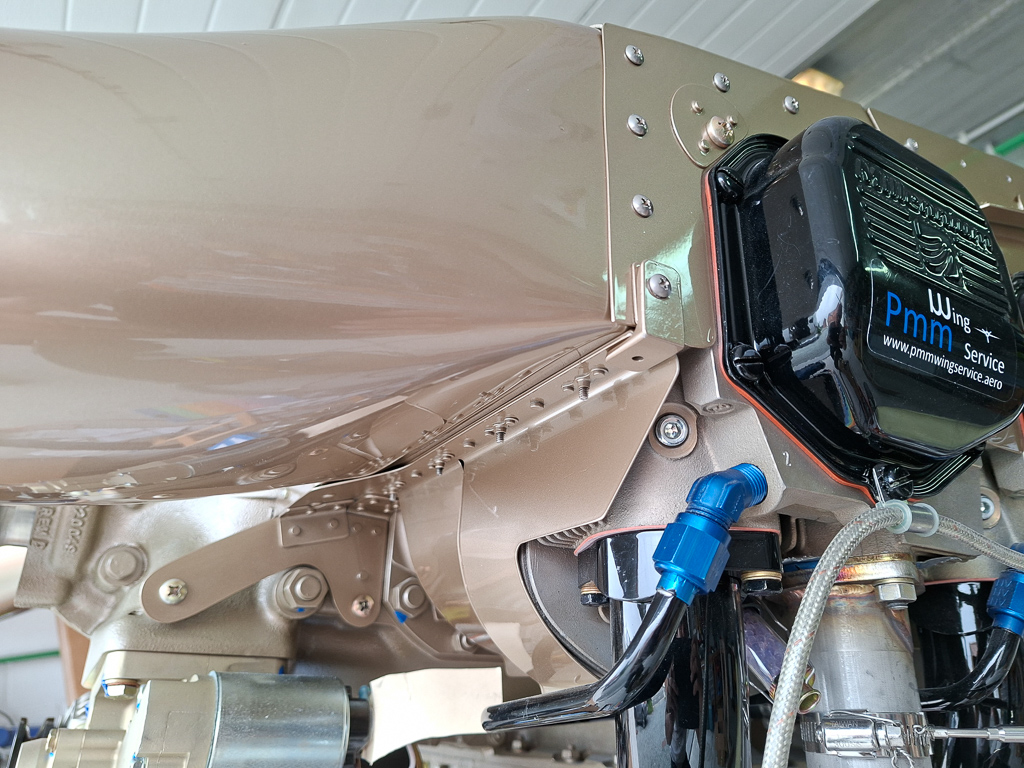
In the image below, I had positioned the aluminum lip, drilled it and rivetted it on the top cowl.
To secure the hinge pin, I have installed a small piece of angle with a hole in the center bottom, The pin just fits through. I installed a nutplate above it which holds a #6 screw to hold a little "door" that closes of the opening in the angle. When the door is open, the hinge tilts back and I can use a phillips screw driver to open the "door" and pull out the hinge pin. If ever I need to replace the spring in the hinge, that will be easy to do.
Door closed and operating nicely.
Stupid me did make a small mistake. As I drilled the aluminum strip, I drilled through the door. It took 2 holes before I realised what I was doing. Fortunately this is epoxy and a little dap of the stuff will close them up. Just more work...
Eh voila ! all done and looking very professional
Spent some more time on adjusting paint gaps on the bottom cowl.
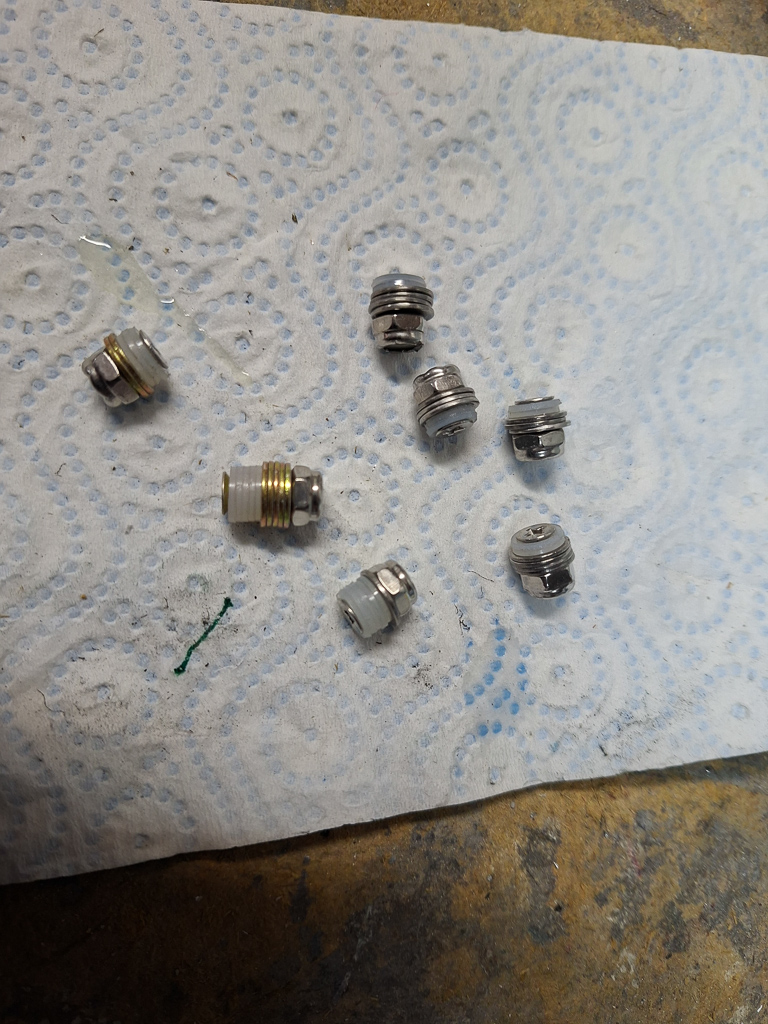
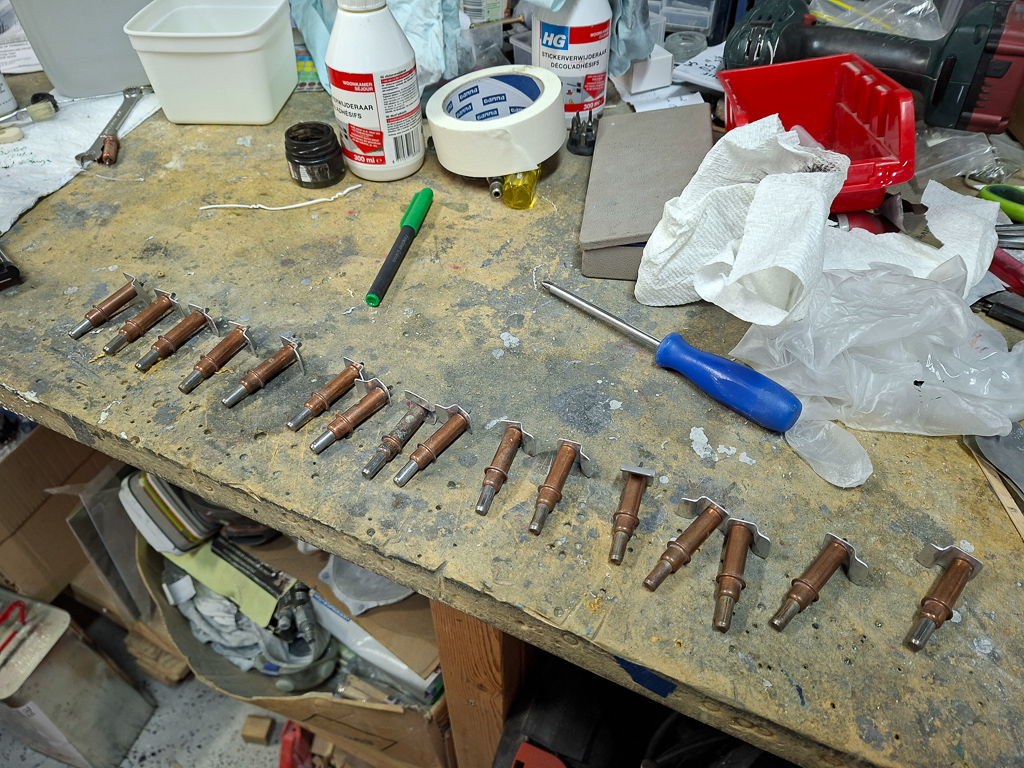
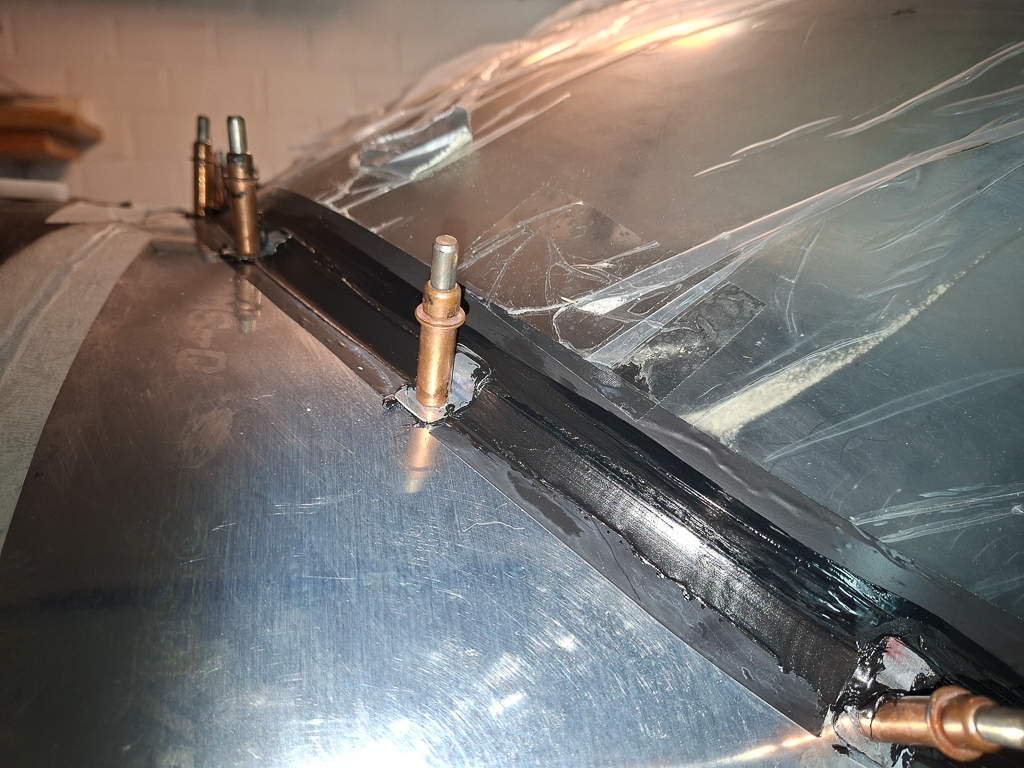
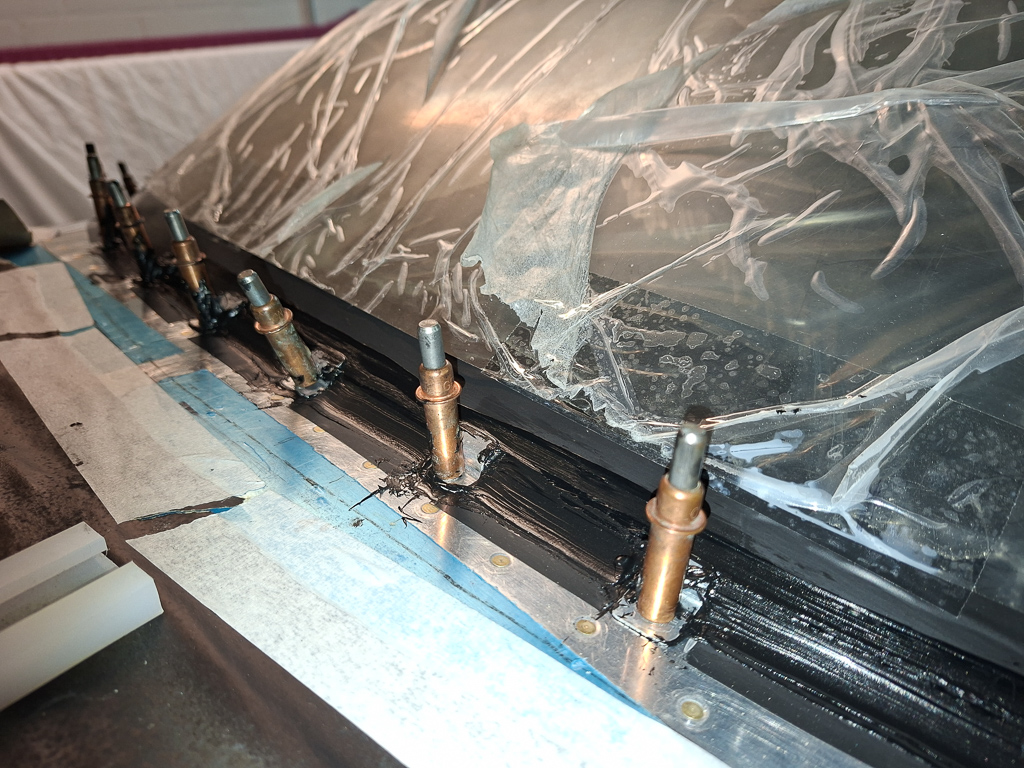
There were still some SkyBolts that had the locking pin inside. They only lock when you remove that pin. Problem with these is that it's hard to remove the pin for the skybolts on the pilot side. There is no oil door opening here as on the other side and the cylinders are in the way to reach in from the air intakes.
A simple trick here was to use a piece of epoxy scrap of the same thickness and make a 15/32 hole in it for the SkyBolt stud. Adjust it as you see it in this image with the stud nice and lever with the washer and remove the locking pin. Give it a half twist left or right and it locks in place.
27/01/26 - Oil door p4 hinge and cessna lock - 4h30
The hinge is final drilled on the oil door. Now it's time to position the Cessna KM610-64 latch to the oil door. The latch can be found at aircraftspruce as product nr 06-00676.
First I have drawn the centerline on the door and top cowl in order to center the push part of the latch in the oil door from the outside.
The latch is pretty simple. It's a housing (in yellow) that hold the latch itself which is controlled by pushing the locking part inwards. The latch is pushed inwards with a spring. What's important in installing this latch is determining the height of the latch in relation to the lip on the top cowling. I didn't want the metal part of the latch to lock an epoxy lip. Instead, I planned to have an aluminum strip rivetted on the epoxy to hold the latch closed. The epoxy would wear out very quickly. The aluminum will finally probably also wear but this can be easily replaced by rivetting a new strip on. In order to test all this, I took some scrap epoxy of the same thickness and simulated the door with this.
I test trilled the hole in the scrap piece and check how it looks. The hole is a bit undersized in the image below. You actually want it one step bigger.
Here I positioned the test piece in place, held the 0.063 aluminum strip in place and checked the locking thightness in relation to the strip on the top cowl. I had 2 extra pieces of epoxy glued under the door.
You can see the extra epoxy pieces here under the yellow body. This distance gives me excellent locking without play on the door.
Then I rivetted the hinge on the cowl so that the position of the door would be final.
Still looks pretty nice when I'm holding the door down. All nice and flat and the spacing for painting all around still looks fine.
Then I made the 2 small extra epoxy strips which will go underneath the latch. Having these well sized is critical as the latch will bond onto them if they are too large.
I'll glue this on with some epoxy and latch work will be finalised tomorrow
Next step on the custom oil door installation is the installation of the hinge that holds the oil door to the top cowling and the lock that will secure it in place. For this I have chosen for the oil door hinge 4640. It is available at aircraft spruce as product number 12-04708 (MFR Model# 4640). The hinge is made by Avery Tools.
This hinge is a lot nicer than the standard hinges as it is not visible from the outside when the door is closed. The hidden hinge has a uniquely shaped arm that allows the hinge to be mounted completely out of view to the underside of the cowling. The center hinge eye is removed for the custom made spring that loads the hinge to be full open when unlatched. If your oil door unlatched it will be full open, eliminating accidentally taking off with the oil door unlatched. The hinge is aircraft quality extruded MS20001-4 hinge with a 3/32” steel hinge pin. One end of the hinge pin is flattened. When installed and closed the hinge pin is gripped tightly by the force of the spring.
This is how it looks like as received from Spruce.
First take the hinge pin out and mark the rivet location for some AN426AD4 countersunk rivets holding the door to the top cowling. AD4 may be a bit of overkill here.
Install the hinge so that the curved part of the hinge just misses the cowling when opening. It's best to remove the spring to make it easier to see the range of motion during mounting. Mount the hinge to the cowling first, then mount the oil door to the hinge. Duct tape is your best friend to keep things in place and test motion before you start drilling. I also taped the door itself to the hinge. I will reinforce the door with a double layer of epoxy so I also taped a temporary spacer on the door.
this is the spacer I used and an image of the taped door below.
The curves in the corners just barely not touch left and right of the hinge which is perfect.
With the door nicely positioned in the extrusion, I drilled the holes in the hinge pin and through the top cowling. First #40, then updrilled #30.
In the next image, I had already cut out te doubler from some stock epoxy and positioned it on the door and underneath the hinge flange. Marked the position of the rivets and drilled the hinge on the door, carefully watching the position of the door in the top cowl.
To make sure it doesn't more, more duct tape... Not only the horizontal position in the door opening is important but also check the height of the oild door in relation to the top cowling. You want everything to sit nice and flat.
Next shot has the door drilled to the hinge flange through the epoxy doubler. Finally today, I will epoxy the doubler to the door by roughning the surface with 80grit sandpaper and making some epoxy paste as glue.
So far soo good. The door fits very nice
Latching of the oil door will be accomplished with a Cessna style latch KM610-64, also available at Aircraft Spruce. This will be the next step in the installation.
My last Spruce order included 8 dehydrant plugs which I installed in the spark plug holes of the engine. The silica gel has a color which is blue when they are dry, If the color turns into pink, the bubbles have absorbed humidity from the cylinder and you should remove them and dry them again by heating. These plugs are used to prevent rust and corrosion in engines while in storage. The pink silica gel may be reactivated (after removing from reservoir) by heating for 16 hours at 250°F or in a microwave.
13/08/25 - Test hanging catto prop first time - 1h
A big day again in my project. Nothing substantially done but I have hung the propellor on the engine prop hub for the first time. I kind of wanted an idea how everything would fit together and what is delivered by Catto with the propellor, spinner and saber extention.
I have a 4 inch Saber extention, spool type. This is required for the Sam James cowling installation. It took a couple of tries to find the way to do this but it's pretty self explanatory once you understand things. The spinner is predrilled and cut and the holes in the spinner plate are also made with nutplates installed. This makes it pretty simple.
Short bolts hang the spool to the prop hub behind the starter flywheel. You bolt these in in a star pattern. I am just doing this temporarily so there is no torqueing involved yet. This will come of a zillion of times. The long bolts holding the propellor and everything forward of the spool extentions are very long. The threads also extend quite far through the extension. This is probably for having enough space if an additional weight plate has to be added up front.
Here is a view with the prop bolted on. This is pretty damned cool seeing this a first time.
Milestone day ! This is one of those days that you know mark the timeline of building your airplane. The moment you hang the engine in the engine mount. After many days of thinking about missing any things on the firewall, I came to the conclusion that this is the right moment to hang the engine and move on to the firewall forward work. There are some more things I need to do on the firewall, but it's not possible to be sure about the exact location to drill large holes in the firewall until I can actually evaluate the position with the engine in place. i'm thinking of the mixture and throttle cable and alternate air cable. Other than those, I'm pretty sure everything on the firewall is in place.
The same thinking goes for the rear of the engine case. Make sure the 45° restrictor fitting for the oil pressure is mounted in the engine case prior to hanging the engine. It's almost impossible to install this once the engine is on the engine mount. Mine was already installed by PMM during engine assembly. While you are at it, also install the other oil cooler fittings in the engine case (in and out). These can also be done later but it's easier now.
First step was to remove the safety straps that held the engine to the wood pallet that was used for transport. I want to keep track of how this was done as this engine is a brand new engine that has not yet been on the test bench. When all is ready, I will need to unhook the engine and bring it to PMM Wingservice to have it running on the test bench for a first time. This has the disadvantage of extra work on removing the engine and all connections again and having to do it again after it has been run. On the other hand, the major advantage is that I do not have to worry about corrosion and idle time of the engine as it has not yet been running. The cylinders are as if they would be in a stock location on a bench waiting for an engine. There has been no movement of the cylinder heads on the cylinder walls and everything has an oil film on it as delivered from Superior Air Parts. Whether building takes me another 3 years or just 1, it won't matter. I'm gladly willing to take that extra work knowing there is no pressure.
The engine was protected well on the front and rear crankcase and supported in the front under the front with some wood block supports. I'll have to keep all this in stock so that I can re use it in the same way when I bring the engine back to PMM.
Using the engine hoist, we pulled it up, removed the pallet and moved it over to the front of the airplane. Alain helped me on this task to keep the engine in position. It's best having some extra hands around when you do this as the engine is heavy and the bolts are not always willing to go in as easy as you think it would.
The last part of the moving is the most critical as you don't want your magneto's or fuel pump to bump into the engine mount. Having one person moving and another one guiding the engine is no luxury.
Also notice I leveled the airplane in flight mode. This is much easier to position the engine than if it would be sitting on all tyres which would require you to position the engine at an angle. This leveled way makes it much easier.
I found some documentation online from someone who did this before and described the process. I studied this carefully and upfront, had a close look at the barry mounts and dyna bolt set. You can read it following this link https://www.myrv14.com/buildlog/20150917/Engine_Hanging.pdf. Vans Aircraft also has some drawings available which are not part of the standard plan set that you receive with the kit.
Study the plans carefully, the barry mounts have to be positioned so that the engine rests on the compression side in the bottom and the compression side in the back on the top mounts. The compression barry mounts are the ones that have a step in the rubber. The non compression ones don't have the ribble on it and look like plain rubber. If I remember well, the non compression ones also are a little larger. Also take care that the washers are in the correct locations. The barry mounts come with one big washer in the box. It's good to assemble the order of all this before starting to move the engine and have thing prepared well. I colored the position of the large washer red in the picture above.
There are 2 lengths in the dyna bolt kit. 2 x AN7-43A and 2 x AN7-44A. The longer ones go on the bottom side, the shorter ones go on the top. The difference is not much more than the length of one of the washers.
Start with the 2 top bolts. The first one is very easy... tighten the bolt but don't torque it yet, you'll probably have to loosen them again working on the bottom bolts. You do need to tighten the first so that the barry mounts compress allowing the other hole to come in line with the engine case. Remember this is a dynafocal mount, the bolts point inwards. If the bolt is not tightened enough on one side, it's impossible to insert the second one. As you tighten the bolts, the barry mounts compress and also position themselves in the engine mount. That's important.
What I found very annoying is that you can't put a socket on the bolt head as the engine mount is in the way. I used an extension on the wrench but that didn't make it easier.
The engine sometimes needs a bit of persuasion to get it in position :) Although I don't think this did much. Found out later it's more important to tigthen the other side and use the engine hoist to lower or lift the engine a bit in order to get a bolt in.
The large washer goes between the compression mount and the crankcase as a spacer for the bottom mounts. On the top mounts, I have put that washer on the compression mounts under the bolt head as you can see in the image below. The image has both top bolts in place and tightened.
From there on, things went less smooth and it took about an hour or 2 before I got the last bolt in so I did not take any more pictures until it was done.
I'll try to describe the further process I took.
As both top bolts were tightened, I lifted the engine a bit using the engine hoist. This allowed me to slip the barry mounts between the case and the engine mount. Don't forget the large washer between the barry cookie and the engine case. Don't forget the compression side of the barry mounts is against the engine for the bottom mounts. Then I lowered the engine again and after some wiggling I was able to put the 3rd bolt in. I did have to loosen the top bolts a bit though.
The fourth bolt is the most difficult one. Looking with a mirror through the hole there was no way the bolt would go in. After a lot of moving up and down, I finally discovered my problem : the washer between the barry mount and the engine case was not aligned and the pressure on it is high enough that it makes it hard to move it. After lifting the engine a bit and tapping on it, I could get it more or less into place. A second trick I used was to take an old bolt which was smaller in size and grind down into a guide pin. Once I could slide that smaller bolt in, I was able to wiggle it around in order to get that washer and the engine hole into alignment. I put some grease on the final bolt shank and finally was able to put it in with only very light tapping of a rubber hammer.
I was feeling relieved as I bolted the final nut on that fourth bolt.
As final step, I torqued the bolts. These are AN7 which take 450 - 500 inch/lbs. I used the middle value of 480 inch/lbs. The engine will still need to come off as mentioned earlier but the position of the engine is very important when installing the cowling so I torqued it to the final value.
Took some pictures of the plane with the engine in place. This surely is a big milestone and is a "feel good" moment during the build.
Happy camper...
As I had some time left, I took out the fuel throttle body. This comes with a plastic spacer.
The orientation of the throttle body was a bit of a mystery at first but soon figured out what side was the throttle lever and which side the mixture. In the image below I installed it on the forward horizontal induction air intake at the cold sump of the engine. In the image below, the throttle lever is the gold colored arm.
Finally I covered the intake with some paper and masking tape in order not to get foreign objects entering the engine.
End of a productive day was off course celebrated with Alain with a good strong Belgian HQ beer.
Some advice on reading my log for fellow builders !
In some articles, I made corrections at later date on the original article to rectify my own stupidities or faults. Read through the entire article if you intend to use my findings/experiences on your own project !
At the Oshkosh airventure 2013, I took this cool shot with Richard VanGrunsven, founder and CEO of Van's aircraft. We had a short chat after he came out of a presentation where he attended putting the young eagles project in the spotlights.
Richard -usually known as "Dick" or "Van" was born in 1939 and became an American aircraft designer and kitplane manufacturer. These days his kits are so popular that the number of VanGrunsven-designed homebuilt aircraft produced each year in North America exceeds the combined production of all commercial general aviation companies.
Oshkosh is to you like Mekka is for a Muslim. If you haven't been there at least once in your life, you will NOT go to aviation heaven !
From Belgium, it's quite a trip but in the last five years of building, we managed to go twice to Oshkosh.
Nothing beats the experience of Oshkosh air venture in Oshkosh Wisconsin.
The first time we went, I visted sun'n fun in spring and decided to also visit Oshkosh. On sun'n fun there were rv's but the experimental parking there is kind of isolated and more difficult to make contact. So my idea before arriving in Oshkosh was, 'wel I hope there will be some RV's'.